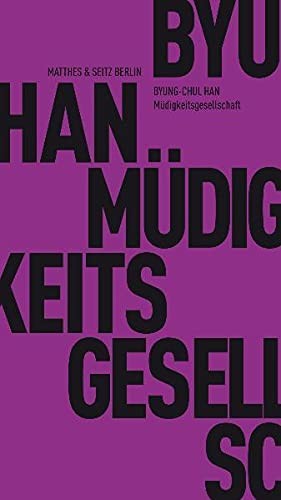
En su obra maestra Byung-Chul Han retrata la subjetividad enferma nacida en el actual contexto, que él describe como la sociedad del cansancio. Plasma la mutación del capitalismo tardío hacia el actual mandato neoliberal, con sus consecuentes alteraciones en la configuración del YO de sus individuos. Cambios estructurales que pasan de una violencia privativa, hostil y negativa a una sociedad no-conflictiva, ‘libre’ y positiva. Esta sociedad del rendimiento provoca enfermedades mentales como depresión y ansiedad, debidas a los principios imperantes de la hiperproductividad y la autoexplotación.
Ante esto, el autor plantea la sociedad del cansancio como consecuencia, pero también como posibilidad. Partiendo de ‘Ensayo sobre el cansancio’ de Peter Handke, aboga por la oportunidad que nos brinda el cansancio en tanto en cuanto sea una detención no incapacitante, un impasse, en esta rueda sin frenos que provoca la sociedad del rendimiento. Es en esta misma línea donde Byung-Chul Han ve en la vida contemplativa una interrupción de la hiperactividad.
Para elaborar su discurso y diferenciar entre la sociedad disciplinaria y la sociedad del cansancio el autor discute con varios autores, como Roberto Espósito, Baudrillard, Alain Ehrenberg, Hannah Arendt, Agamben y con la obra Bartleby, el escribiente, de Melville. A su vez, utiliza a otros autores en pro de su análisis de la sociedad enferma actual, como Walter Benjamin, Merleau-Ponty, Nietzsche y, principalmente, Handke. Personalmente, si bien este aspecto puede enriquecer su ensayo, creo que el desconocimiento de las tesis de dichos autores dificulta la lectura de este ensayo.
Además, hay un par de aspectos que no me convencen de esta obra. Me sorprende la omisión de conceptos como capitalismo y neoliberalismo en una obra que precisamente trata de diferenciarlos y de analizar a este último. No sé si justo este silenciamiento habrá sido clave para el éxito de este libro. Asimismo, discrepo de la idea de que el sujeto actual esté libre de explotación externa, que solo sea interna y que ya no influyen las instituciones propias de la sociedad disciplinaria, que el autor sitúa en un pasado que terminó junto a la Guerra Fría, pues el peso de las instituciones totales sigue cayendo sobre la población.
No obstante, creo que el gran valor de esta obra es la radiografía que hace Byung-Chul Han de la sociedad global actual y de cómo su positividad es una violencia encubierta que enferma mentalmente a su población, hasta el punto de convertirla en verdugo y víctima de su propio malestar, y de despersonalizarla en aras de la producción y del rendimiento. Un análisis que, si bien no es novedoso, sí es accesible para el gran público. Asimismo, me sorprende gratamente que el autor vea en la contemplación no un acto pasivo y asimilatorio, sino un acto de rebeldía en tanto que se trata de una negativa ante la violencia positiva, un acto consciente de oponerse al actual ritmo y al sentir de vida.