KeruWolf@bookwyrm.social (e)k Ursula K. Le Guin(r)en Historias de Terramar 4 Tehanu liburuaren kritika egin du
None
5 izar
Honesto e intrigante. 👍
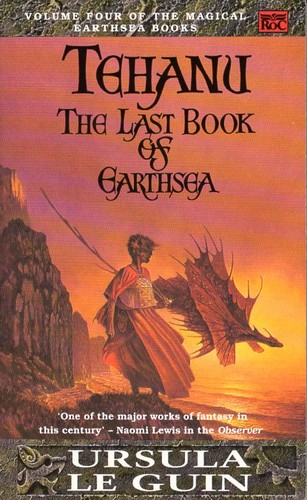
English hizkuntza
1993ko aza. 3a(e)an Penguin(e)n argitaratua.
In this final episode of "The Earthsea Cycle", the widowed Tenar finds and nurses her aging friend, Sparrowhawk, a magician who has lost his powers.
Honesto e intrigante. 👍
I generally prefer novels to short stories, and might have skipped over this entry in the Earthsea series if I wasn't reading all of them with a group. So, I'm glad that I am reading them with a group, because I really enjoyed this book, and think that it is an essential part of the series.
I enjoyed some of the stories more than others, but there were none that I disliked at all. Overall, they very much enriched my understanding of Earthsea.
One of the things that is fascinating to me about reading this series is that I can see Le Guin growing as a writer. In particular, I see her developing the confidence to write realistic female characters, rather than the unsatisfying female characters which I think is what she felt she had to write in her earliest books (when she included female characters at all).
Cuentos que dan forma a Terramar. Es genial ver la evolución de la autora, con temas cada vez más complicados y actuales
Edukiari buruzko abisua some spoilers about the end
This book was both heartbreaking and heartwarming. It was heartbreaking because there is a constant violence against the poor little girl, and she seems to suffer so much. But then things turn to a positive outcome at the end, and she speaks to Kalessin and calls Ged and Tenar her father and mother (when there where just hints of Tenar thinking of her as "adoptive daughter"). I was feeling joy while reading those pages. At the fourth book in the series, I think I see a kind of tidal cycle between male- and female-focused stories. Books 1 and 3 were pretty much male-focused and books 2 and 4 are strongly female-focused. It's explicit, the Place of the Tombs of Atuan has no men, only eunuchs. In "Tehanu" the female perspective is weaved in almost every page, both in the grand scheme of things and the everyday life. I couldn't help noticing a Christian analogy for the final scene when Kalessin says that Tehanu is their daughter, given to Ged and Tenar who should care for her - but it's Tehanu who chooses to stay and help them. So it's actually a radically different approach than the Christian God.